
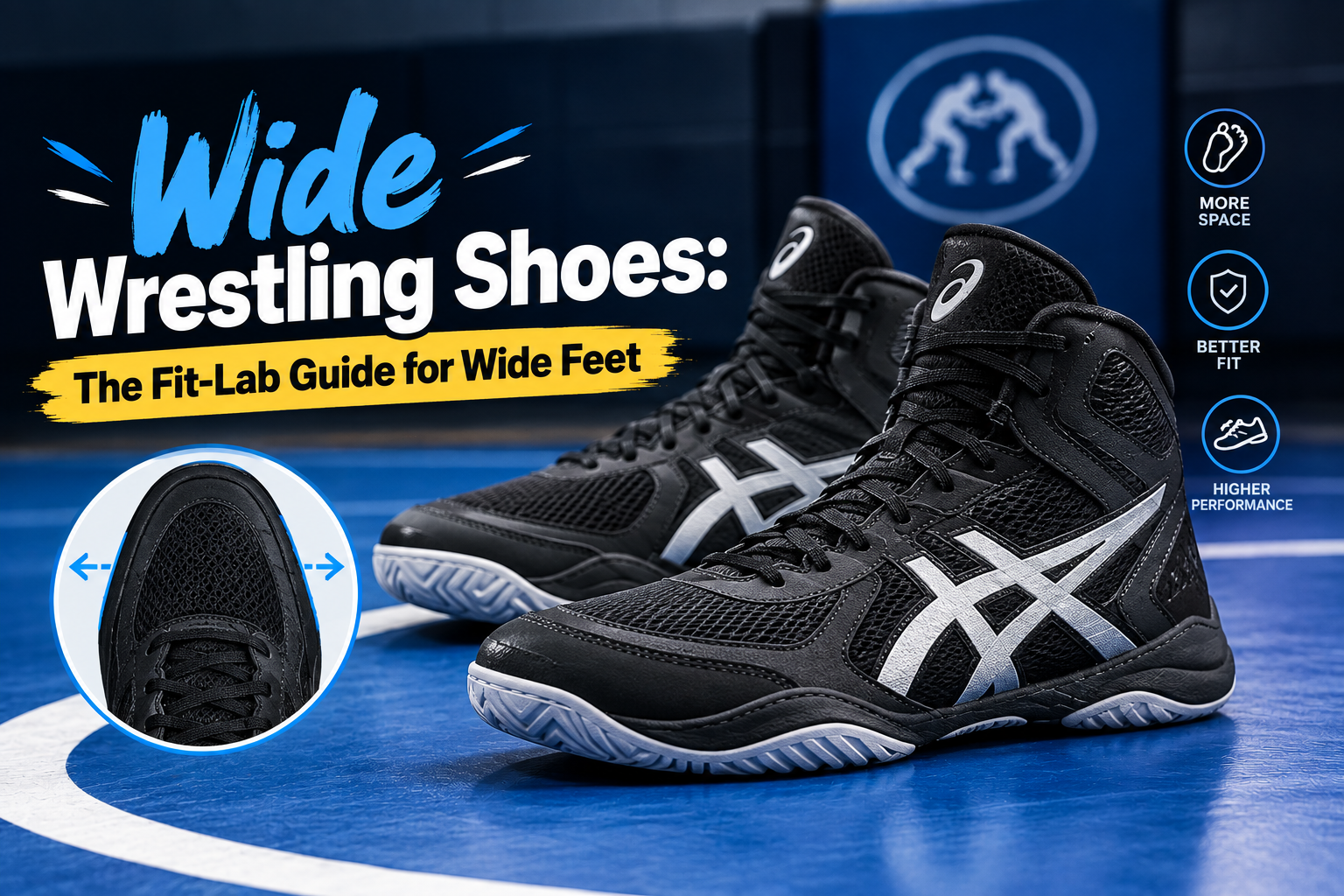
If wrestling shoes feel tight across the ball of your foot, buying a longer size may not solve the problem. You may need a genuinely wider last, a roomier toe box, more upper volume, or a different heel shape. Those are different fit problems, and the size printed on the box does not tell you which one you have.
This guide explains how to find wide wrestling shoes without confusing length with width. It also shows how Wrestling Fit Lab will compare models: measured internal width, tester foot profiles, movement checks, and side-by-side photos. Where a model has not yet been measured by us, it is labeled as unverified rather than presented as a tested recommendation.
What counts as a wide wrestling shoe?
The word "wide" can describe several different things:
- an official width option, such as a product sold as Wide or 2E;
- a naturally roomier shape in the forefoot;
- a stretchy upper that accommodates more volume;
- a model that feels wide only because it has a soft, forgiving material;
- a retailer's opinion based on customer experience rather than a published measurement.
Those labels are not interchangeable. A shoe with a flexible mesh upper may stretch around a broad foot, but that does not prove that its outsole platform is wide enough. A true wide-width version changes the shoe's fit specification, but it still may not suit every foot shape. One wrestler may have a broad ball of the foot and a narrow heel. Another may need extra depth over the toes. Both people can describe their feet as wide and need different shoes.
ASICS currently lists the Snapdown 4 Wide as a separate wrestling-shoe model, and its men's wrestling category includes a width filter. The product page identifies the model as a wide version, but it does not publish an internal forefoot measurement for the consumer to compare against their foot. ASICS Snapdown 4 Wide
That is why our fit lab records both the manufacturer's label and our own measured dimensions. A model can be officially wide and still feel wrong for a particular foot.
Wide, roomy, and oversized are not the same
It helps to separate four fit dimensions before you change sizes.
Too short
Too narrow
Too shallow
Too roomy
The widest part of your foot should line up with the widest part of the shoe. The American Orthopaedic Foot & Ankle Society calls this out in its fitting guidance, along with measuring both feet, fitting the larger foot, and checking the shoe while standing and walking. FootCareMD: 10 points of proper shoe fit
If the pressure is on the sides while your heel and longest toe are in the right places, treat the issue as width or shape first. If your whole foot moves forward, check heel hold and lacing before ordering another size.
Signs your wrestling shoes are too narrow
A narrow fit can be obvious, but it is often mistaken for a normal wrestling-shoe feel. Wrestling shoes should feel close. They should not make your foot numb.
Look for these signs:
- Pressure at the toe joints. The big-toe joint or the little-toe side feels compressed even when the shoe is the correct length.
- Numbness or tingling. Symptoms appear after the laces are tightened or after several minutes of movement.
- A visible sidewall bulge. Your foot pushes beyond the edge of the outsole or the upper stretches sharply over one area.
- Lower eyelets left loose. You loosen the forefoot laces to tolerate the shoe, then the foot moves because the shoe cannot hold you evenly.
- Pressure that worsens during stance work. The shoe feels acceptable while seated but becomes restrictive when your foot spreads under load.
- Relief immediately after removal. A concentrated hot spot disappears when you take the shoe off.
One sign is not a diagnosis. Sock thickness, lacing, the shoe's shape, and the length of the shoe all affect what you feel. Use several checks together.
How to measure your feet for wide wrestling shoes
Measure at the end of the day, wearing the socks you expect to use for wrestling. FootCareMD recommends fitting the larger foot and not relying on the size you have worn in another brand. Its athletic-shoe guidance also recommends trying shoes with the same type of sock used for the activity.
Length
- Tape a sheet of paper to a hard floor with one edge against a wall.
- Stand with your heel lightly touching the wall and your weight evenly distributed.
- Mark the end of your longest toe. It may not be your big toe.
- Measure from the wall to the mark.
- Repeat on the other foot.
- Use the longer measurement when you compare size charts.
Do not add a guessed toe allowance to the measurement. The measurement is the length of your foot. Toe room is checked later, inside the actual shoe.
Forefoot width
Measure the widest part of the foot, usually across the ball just behind the toes. Keep the foot loaded while standing. A seated measurement can understate the width you need on the mat.
The number is useful for comparing your own feet over time, but it is not a universal conversion into a wrestling-shoe width. Brands use different lasts, materials, and width labels. A foot width that fits one model may not fit another model at the same nominal size.
Foot volume and instep
Width is only one part of the fit. If the sides feel acceptable but the laces press hard across the top of your foot, you may need more instep volume. If you have to tighten the top of the shoe to stop heel movement, the shoe may be too roomy at the heel even if the forefoot feels good.
Record three notes for each foot:
- length in millimeters or centimeters;
- widest forefoot measurement;
- where pressure appears when you wear a correctly sized shoe.
The Wrestling Fit Lab size guide can compare your measured length with general Nike and adidas charts. It is a starting point, not a width guarantee or a model-specific fit verdict.
How to test a wide wrestling shoe at home
Try the shoes indoors on a clean surface while returns are still possible. Use the socks you will wrestle in, lace the full shoe, and keep both shoes on for several minutes.
1. Check the length before the width
Stand up. Your longest toe should not be jammed into the front. Then take a controlled penetration step. If the toes hit the front only when the foot drives forward, check whether your heel is sliding forward. A shoe that is too short and a shoe with poor heel hold can produce a similar feeling.
2. Check the forefoot platform
Look down while standing. The widest part of the foot should sit over the widest part of the outsole. The upper should contact the foot without a sharp ridge or a pronounced bulge at the sidewall.
Do not judge only by how much the material stretches. A stretchy upper can hide a narrow platform until you push laterally.
3. Check toe movement
Your toes should lie flat and move slightly. They should not curl to create room. They should not be pressed together by the sidewalls, and they should not rub the roof of the toe box.
General athletic-shoe guidance recommends a comfortable fit from the start and warns against expecting a painful shoe to become correct after a break-in period. Wrestling shoes may soften as the materials flex, but breaking in should not be used to excuse numbness, sharp pressure, or altered movement.
4. Check the heel after lacing
Use even tension from the bottom eyelets to the top. Rise onto the balls of your feet, take a few stance steps, and pivot slowly. Your heel should stay seated without requiring painful lace pressure.
If the forefoot is comfortable only when the heel is loose, or the heel is secure only when the forefoot is crushed, the model may not match your foot shape.
5. Keep moving for several minutes
A standing fit can conceal a problem. Test a stance, level change, penetration step, lateral shuffle, and pivot. Stop if you feel numbness, sharp pain, or skin rubbing. Never test a returnable pair on a mat if doing so could mark or contaminate the outsole.
Should you size up for wide feet?
Sometimes a half-size increase gives a particular foot more usable room, but it is not a reliable width solution. It also increases the distance from the heel to the toe. That can create heel slip or force the toes to grip the floor.
Use this order of decisions:
- Confirm the measured length using the current brand chart.
- Check whether the model is sold in a genuine wide width.
- Look for a different model with a broader or more suitable forefoot shape.
- Try the next half size only if length, heel hold, and toe clearance still pass the movement test.
The manufacturer's chart should be the first reference for size. Nike notes that the CM value printed on a box is not the same as foot length in centimeters, so do not treat a shoe-label number as a direct measurement. Nike men's footwear size chart
For wide feet, the best outcome is a secure heel and enough forefoot room at the correct length. A longer shoe that solves one pressure point but lets the heel move is not a complete fix.
Which wrestling shoes are available in wider options?
The cards below separate published information from Wrestling Fit Lab evidence. It is intentionally conservative. A retailer description or community report can tell us what deserves testing, but it does not replace an internal measurement.
ASICS Snapdown 4 Wide
Official 2EASICS Snapdown 4 Regular
StandardASICS Aggressor 6
CandidateNike Inflict 4
Unverifiedadidas Combat Speed 4
UnverifiedOther Models
UnverifiedWrestlingMart's wide-shoe guide is useful as a list of models to investigate, but it mixes official labels, retailer interpretation, and fit impressions. For example, it calls the ASICS Snapdown 4 Wide a true wide model, describes the adidas Combat Speed 4 as medium to wide, and discusses a narrower feel for the Nike Inflict 4. Those are leads for testing, not measurements. WrestlingMart wide wrestling shoe guide
ASICS also says its men's wrestling range includes different sizes and widths, and its category page exposes a width filter. The filter is useful when shopping, but a filter does not tell you how the shoe will fit your foot. ASICS men's wrestling shoes
How Wrestling Fit Lab measures wide wrestling shoes
We will use the same protocol for each model so that the comparison stays useful.
Internal measurements
For each tested size, we will record:
- internal length from heel seat to the usable front of the shoe;
- internal width at the ball of the foot;
- width at the toe-box opening where the foot begins to taper;
- upper height or usable volume at the forefoot when the design allows it;
- outsole width at the forefoot;
- measured shoe size and width label.
The measurement must identify the method, tool, size, and measurement point. A single maximum width number without a location is not enough for a useful comparison.
Tester profiles
Each tester profile will record foot length, forefoot width, usual shoe size, sock thickness, and the location of any pressure. We will not call a shoe wide because one tester likes it. The test needs several feet with different shapes and a description of who the result may suit.
Movement checks
Testers will wear the shoes with wrestling socks and perform controlled stance steps, level changes, penetration steps, lateral shuffles, toe rises, and pivots. The score will separate forefoot comfort, heel hold, side pressure, toe clearance, and movement security.
Photos
Side-by-side photos will show the same size, the same camera distance, and the same foot position where possible. Photos can show shape and upper stretch. They cannot prove internal dimensions by themselves.
Until these measurements, tester notes, and photos are complete, a row in our comparison table will remain labeled "pending testing." That is more useful than inventing a ranking from product photos or a single customer's review.
What to look for in a wide wrestling shoe review
Many shoe reviews answer "Does it feel good?" but do not explain whose foot was inside the shoe. For a wide-foot buyer, look for:
- the tester's foot length and forefoot width;
- the exact model, size, and width label;
- the socks worn during the test;
- whether the shoe was tested standing and moving;
- photos of the foot in the shoe, including the forefoot;
- a return or exchange policy;
- whether the reviewer measured the shoe or only described the feel.
Phrases such as "roomy," "wide-friendly," and "fits true to size" need context. A narrow foot may call a shoe roomy. A wrestler who sizes up may report more width while actually wearing a longer shoe. A soft upper may feel comfortable for ten minutes and still place the foot over a narrow platform.
Wide feet and youth wrestlers
Growing feet need a secure fit now. Buying a much longer shoe for future growth can allow the foot to slide, especially during shots and pivots. Measure both feet, use the larger foot as the starting point, and recheck the fit during the season.
Ask a young wrestler where the shoe feels uncomfortable instead of asking only whether it fits. Useful questions include:
- Does the side of your foot feel squeezed?
- Does any toe touch the front when you drive forward?
- Does your heel move up and down?
- Do you feel tingling or rubbing after several minutes?
Adult wide labels do not automatically translate to a youth model. Check the manufacturer's youth chart and the exact product width before ordering.
Common mistakes when shopping for wide wrestling shoes
Mistake 1: Ordering a full size up immediately
This adds length before you know whether length is the problem. Start with measurements and the model's chart.
Mistake 2: Treating stretchy fabric as a wide platform
The upper can stretch while the outsole stays narrow. Check where your forefoot sits over the platform.
Mistake 3: Using a daily sneaker as the reference
Daily shoes vary in shape and volume. Compare foot measurements and the current wrestling-shoe chart instead of assuming the same number will transfer.
Mistake 4: Ignoring the heel
Extra forefoot room is not helpful if your heel lifts during a penetration step. Width and heel security have to work together.
Mistake 5: Expecting break-in to solve pain
Materials can flex, but a sharp pressure point, numbness, or altered movement is a reason to stop and reassess the size or model.
Frequently asked questions
Are there true wide wrestling shoes?
Yes. Some models are sold in a separate wide version. ASICS currently lists the Snapdown 4 Wide as its own wrestling-shoe product. A wide label is useful, but it still needs to be checked against the wearer's foot shape and heel fit.
Are wrestling shoes for wide feet supposed to feel loose?
No. A wide shoe should give the forefoot enough room without allowing the heel or midfoot to slide. The target is even contact and secure movement, not a loose fit.
Can I wear a normal-width wrestling shoe if I have wide feet?
You may be able to if the model's shape and upper accommodate you, but test it carefully. Check the forefoot platform, toe movement, side pressure, and heel hold. Do not rely on the word "regular" or on a photo.
Should I size up or buy a wide width?
If the length is correct and the sides are tight, a true wide option or a different model is usually the cleaner problem to investigate. A size increase may help some feet, but it also adds length and can create heel movement.
What if wide wrestling shoes still feel tight?
Recheck your foot measurement, sock thickness, lacing, and the location of the pressure. If the shoe is a true wide model but still pinches, its shape or volume may not match your foot. Try another last rather than assuming you need more length.
What is the best wrestling shoe for wide feet?
There is no responsible universal answer until the model, size, foot measurements, and test conditions are known. We will publish model recommendations only after measuring internal widths, testing wide-foot wrestlers, and showing side-by-side photos. Until then, use the comparison table as a shortlist of models to investigate, not a ranking.
The bottom line
Wide wrestling shoes should solve a width problem without creating a length or heel problem. Measure both feet, identify where the pressure occurs, and test the exact model while standing and moving in wrestling socks. Look for an official wide option when it exists, but still check the platform, toe box, upper volume, and heel hold.
Use the Wrestling Fit Lab size guide for a length-based starting point, then confirm the fit in the exact shoe. If you still feel side pressure, do not simply keep moving up in size. Compare a different model or width and record what changed.
Editorial and production notes
Evidence standard: This guide uses official manufacturer product and size pages, orthopaedic shoe-fitting guidance, and retailer information only as leads for future testing. It does not claim that Wrestling Fit Lab has measured or worn the models listed in the comparison table.
Required original evidence before publication:
- Measured internal width and outsole width for at least three wide or wide-friendly models.
- At least two wide-foot testers with recorded foot length, forefoot width, and usual size.
- Side-by-side photos using a repeatable camera position and size label.
- A measurement-method note showing tools, measurement points, and whether the insole was removed.
- Return-policy checks for every linked retailer.
Suggested featured-image brief: A pair of unbranded black wrestling shoes beside a simple foot-measurement setup, with a visibly broader forefoot profile on one shoe. Landscape 1600 × 900, premium black, red, and neutral palette, no baked-in text, no logos, no athlete required.
Suggested image alt text: Wide wrestling shoes beside a foot-measuring ruler and width guide.
Affiliate comparison-table CTA: Add product links only after confirming current availability, size options, width labels, and the site's standard affiliate disclosure.
Internal-link QA: Confirm the live URL for /how-should-wrestling-shoes-fit/ and /size-guide/ before publishing. Add a reciprocal link from the fit article to this hub if the link is not already live.
Reviewer fields:
- Writer: [Name]
- Technical reviewer: [Name and relevant credentials]
- Last reviewed: September 6, 2026
- Next review: March 2027 or sooner if model availability or manufacturer charts change
Sources checked: